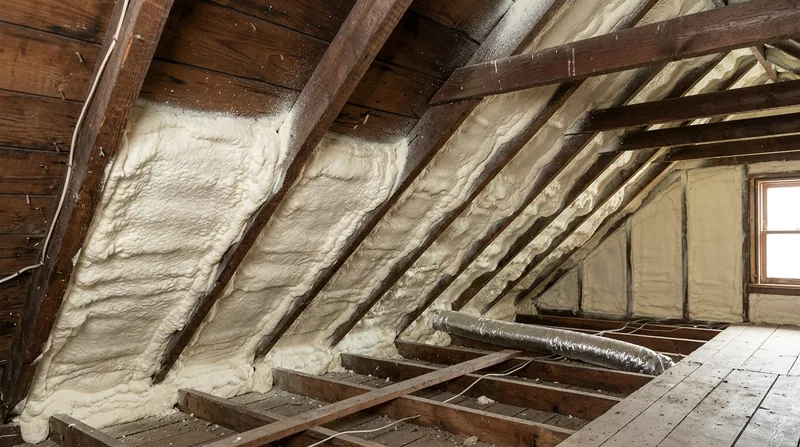




Iowa City's oldest neighborhoods, from the Northside to Longfellow, are home to early-1900s houses split into student rentals and family residences. Many of these homes carry balloon-framed walls and attics insulated decades ago with settled fiberglass batts that leave cold spots overhead in winter and allow humid summer air to penetrate the roof deck. Mid-century ranches across Johnson County have easier attic access but thin original insulation, while newer two-story homes in Coralville and North Liberty bring vaulted ceilings and rooms over garages that demand careful attention to the roof assembly. Zone 5A winters are cold and windy, pushing conditioned air out through top plates and roof penetrations; summers are hot and humid, driving moisture inward through leaky roof decks. Attic spray foam insulation in Iowa City stops that seasonal heat loss and humidity penetration by sealing the attic floor or roof deck with a continuous air barrier and high R-value, whether you are topping up an older home or closing off a cathedral ceiling in a newer build. Since 2014, we have sprayed attics across Greater Iowa City with both closed cell and open cell foam, controlled thickness, and mechanical ventilation during cure so your home stays comfortable year-round and your energy bills reflect the work done.
Why Attic Insulation Fails in Johnson County Homes
Fiberglass batts settle over time, leaving gaps and cold spots where they no longer touch the ceiling. Older attics in Iowa City often show uneven coverage, compressed batts near eaves where they block ventilation, and moisture stains on roof decks after heavy rain or snowmelt. Student rentals near campus turn over every August and are rarely re-insulated between tenants, so heating and cooling costs spike. Newer homes with cathedral or vaulted ceilings cannot use blown-in insulation safely because the attic space is too tight and uneven, and fiberglass batts between rafters leave air gaps at the top plates where they meet the exterior wall.
- Settled fiberglass leaves cold spots overhead in bedrooms and living rooms during Iowa City winters.
- Moisture moves through leaky roof decks in summer, raising cooling costs and creating conditions for mold.
- Attic ventilation conflicts with fiberglass coverage in many older homes, forcing a choice between insulation and airflow.
- Vaulted or cathedral ceilings in newer homes cannot be safely insulated with batts or blown-in fiber.
- Air leaks around penetrations, top plates, and eaves bypass insulation and account for a large fraction of winter heat loss.
Spray foam seals these gaps and creates a continuous air barrier, which is why it outperforms fiber in high-performance attics and sealed roof decks.
Key info: Northside and Longfellow homes often have attics with settled batts and balloon-frame walls; Coralville and North Liberty subdivisions frequently feature vaulted ceilings and rooms over garages that need roof-deck insulation. Both scenarios call for spray foam, not fiber.
For guidance on what the Iowa City Building Department requires for attic ventilation and thermal barriers, see the City of Iowa City Building Services page.
How We Insulate Attics in Iowa City: Our Process
We start with a site visit to measure the attic, identify air leaks, check for moisture or contamination, and determine whether you need floor insulation, roof-deck insulation, or both. We specify R-value and foam thickness in writing before any work begins, so you know exactly what you are getting. On spray day, we set up mechanical ventilation to manage fumes during cure, apply foam at the correct drum temperature and ratio, and specify a 24 to 48-hour re-entry window. We do not spray over wet, moldy, or contaminated substrates; if we find moisture, we walk away and refer you to the right specialist.
- We schedule a free estimate at your home to assess attic size, access, existing insulation, and air-leak sites.
- We provide a written quote with R-value, board-foot total, and foam thickness so there are no surprises.
- We confirm permits and any local requirements with the Iowa City Building Department on your behalf.
- On spray day, we install mechanical ventilation, apply foam at controlled thickness per pass, and leave the attic unoccupied for 24 to 48 hours.
- We inspect the finished work and provide documentation of thickness and coverage for your records.
This approach ensures the foam cures properly, off-gasses safely, and delivers the R-value promised on your estimate.
Example: A 1,200 sq ft attic in a Longfellow rental house with settled fiberglass and air leaks at the rim joist takes one full day to spray at 4 inches of closed cell (R-24) or 6 inches of open cell (R-21). We set up ventilation fans, spray in passes to avoid over-thickness, and leave mechanical ventilation running for 24 hours. The homeowner re-enters after 48 hours.
Learn more about closed cell spray foam insulation and open cell spray foam insulation to understand which method suits your attic.
Attic Spray Foam Insulation Methods: Closed Cell vs. Open Cell
| Approach | Description | Best for |
|---|---|---|
| Closed Cell Spray Foam | High-density foam (1.5 to 2 lbs per cubic foot) with an air barrier and vapor barrier built in. R-value approximately 6.0 to 6.5 per inch. Requires 4 to 5 inches for R-24 to R-32 in attics. | Sealed roof decks, cathedral ceilings, homes in humid climates (like Iowa City summers), and attics where space is tight and moisture control is critical. |
| Open Cell Spray Foam | Lower-density foam (0.5 to 1 lbs per cubic foot) with air-sealing properties but no vapor barrier. R-value approximately 3.5 per inch. Requires 6 to 7 inches for R-21 to R-24 in attics. | Attic floors in vented attics, sound dampening, cost-conscious retrofits, and homes where vapor management is handled separately by roof venting. |
| Hybrid or Top-Up with Blown-In Fiber | Spray 2 inches of open cell foam to seal air leaks and penetrations, then blow cellulose or fiberglass over the top to reach target R-value at lower cost. | Attics with sound existing fiberglass that only need air sealing and a modest R-value bump. Not suitable for cathedral ceilings or sealed roof decks. |
| Roof Deck Insulation (Closed Cell Only) | Spray foam directly on the underside of roof sheathing to create a sealed, conditioned attic. Requires 5.5 to 6 inches of closed cell for R-38. Requires a thermal barrier (fifteen-minute fire rating). | Cathedral and vaulted ceilings, bonus rooms over garages, and homes where the attic will be conditioned or used for storage. |
On a simple attic top-up where existing insulation is sound and air leaks are minor, blown-in fiber alone may be the right answer and we will say so. Spray foam is the best choice when you need an air barrier, moisture control, or the space to fit full R-value in a tight geometry.
Attic Spray Foam Insulation Cost in Iowa City: What to Expect
Attic spray foam in Iowa City typically starts at $1.50 per square foot for open cell on an attic floor and rises to $2.50 to $3.50 per square foot for closed cell on a roof deck or in a tight cathedral ceiling. A 1,200 sq ft attic floor at 4 inches of closed cell runs roughly $1,800 to $2,400 before any site-specific adjustments. Access, existing insulation, the presence of air leaks or penetrations, roof geometry, and whether we need to remove old insulation all move that number up or down.
The board-foot total is the clearest way to compare quotes: a 1,200 sq ft attic at 4 inches of closed cell is 400 board feet. At $4.50 to $6.00 per board foot, that is $1,800 to $2,400. If a contractor quotes you $2.50 per sq ft with no mention of thickness or board feet, you do not have a real estimate.
Get two or three written estimates that specify R-value, thickness, and board-foot total. The cheapest quote is often the first sign of corners cut: no mechanical ventilation during cure, immediate re-entry promised, or insurance that cannot be verified. A realistic estimate in Iowa City includes site visit, written specs, full insurance, and a clear re-entry window.
For a detailed breakdown of pricing across different attic scenarios and service areas, visit our pricing page.
What to Look for When Hiring an Attic Spray Foam Insulation Contractor Near Iowa City
Spray foam is a high-skill trade. A poor installation leaves odor, off-gassing, and wasted money. The right contractor is fully insured, carries a written estimate with R-value and thickness, and commits to a safe cure process with mechanical ventilation. Hiring near Iowa City means someone with a local address, local plates, and accountability when the job is done.
- Verify the contractor is fully insured and can provide a certificate of insurance naming your address.
- Get written estimates from at least two contractors that specify R-value, foam thickness in inches, board-foot total, and the re-entry window.
- Ask whether the contractor pulls permits and works with the local building department; if they say no, that is a red flag.
- Check references and ask past clients about odor, cure time, and whether the finished work matched the estimate.
- Confirm the contractor uses mechanical ventilation during cure and does not promise immediate re-entry or a twenty-four-hour guarantee.
- If your home is in an HOA or a historic district, confirm the contractor understands any local architectural or permit rules.
The honest contractor will tell you when spray foam is overkill and a simpler option is the right call. That transparency is the strongest indicator of someone worth hiring.
Call us for a free, no-obligation estimate at (319) 600-6306, or contact us online to schedule your attic evaluation today.
Attic Spray Foam Insulation in Iowa City: Pricing Guide
| Service | Price | Details |
|---|---|---|
| Open Cell Attic Floor Insulation | Starting at $1.50/sq ft | 6 to 7 inches for R-21 to R-24 on attic floors in vented attics; cost rises with access difficulty and removal of old insulation |
| Closed Cell Attic Floor Insulation | Starting at $2.00/sq ft | 4 to 5 inches for R-24 to R-32; includes air and vapor barrier; higher cost reflects moisture control and durability in humid climates |
| Closed Cell Roof Deck or Cathedral Ceiling Insulation | Starting at $2.50/sq ft | 5.5 to 6 inches for R-38 to R-43; tight geometry and thermal barrier requirements increase labor and material cost |
| Insulation Removal and Replacement | On estimate | Removal of old fiberglass, vermiculite, or failed foam requires site assessment; cost depends on volume, contamination, and disposal logistics |
| Travel and Site Visit | Included | No mileage fee or travel charge in Iowa City, Coralville, North Liberty, and surrounding Johnson County service areas |
| Free Estimate | No obligation | Written quote within 24 hours with R-value, thickness, and board-foot total; call (319) 600-6306 to schedule |
Indicative pricing, the exact cost depends on square footage, finish, and site access. Free personalized estimate within 24h at (319) 600-6306.


