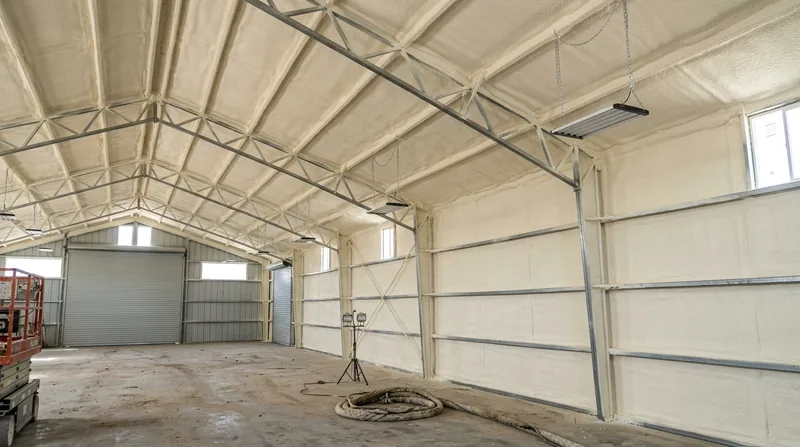




Metal building and barndominium spray foam insulation in Iowa City stops the condensation that pools under cold roof decks every winter and drips onto equipment, vehicles, and stored goods below. Rural Johnson County is dotted with metal shops, equipment sheds, and barndominiums converted from old dairy and grain structures, and nearly all of them sit on the same problem: humid Iowa air rises into an uninsulated or poorly insulated metal shell, hits the cold steel roof and walls during winter, and condenses into water that corrodes fasteners, promotes rust, and creates an environment where mold and moisture damage thrive. The IECC zone 5A climate here drives that cycle hard, with cold winters pushing moisture inward through every gap and warm, humid summers reversing the flow. Spray foam applied directly to the metal deck and wall girts creates a continuous thermal and air barrier that stops the temperature swing that causes sweating in the first place. We have been insulating metal buildings and barndominiums across Johnson County, Linn County, and the surrounding region since 2014, and we know the exact failure modes that dominate this landscape.
Why Metal Building and Barndominium Insulation Matters in Iowa City and Johnson County
Metal structures in rural Iowa face a unique insulation challenge that wood-frame homes do not. Steel conducts cold directly from outside air to the interior space, creating a surface cold enough to condense moisture even when the air inside is only moderately humid. A shop in Solon or a converted barn near Tiffin with an uninsulated metal roof will sweat heavily on winter mornings, and that moisture migrates into every corner, rusting tools, damaging inventory, and shortening the life of HVAC equipment and electrical systems. The problem worsens in spring and fall, when day-night temperature swings are largest. Spray foam insulation applied to the underside of the metal roof deck and along wall girts eliminates that cold surface, keeping the interior air at a temperature where condensation cannot form.
- Condensation under metal roofs and walls causes rust, corrosion, and structural deterioration that accelerates with every heating season.
- Uninsulated metal buildings lose heat rapidly in winter, pushing utility bills up and making the space uncomfortable for work or habitation.
- Spray foam creates a continuous thermal barrier that stops air infiltration and moisture migration at the source, not as an afterthought.
- A sealed metal building holds temperature more evenly, reduces the load on heating and cooling equipment, and protects inventory and equipment from humidity damage.
- Barndominiums with spray foam insulation can be occupied year-round without the smell of mold or the constant battle against condensation.
Controlling moisture in a metal structure is not a luxury; it is the foundation of a building that will last and function reliably in Iowa's climate.
Key info: A metal equipment shed in North Liberty that sweats heavily in winter will show rust on fasteners and corrosion on electrical conduit within two to three seasons if left untreated. Spray foam insulation stops that cycle immediately and pays for itself in reduced equipment replacement and maintenance costs.
For more context on how spray foam controls moisture in enclosed spaces, see our closed cell spray foam insulation page, which details the R-value and moisture resistance that makes this product the standard for metal buildings.
How We Insulate Metal Buildings and Barndominiums in Iowa City
Metal building spray foam insulation begins with a site inspection to assess the roof deck, wall girts, existing moisture damage, and any areas where air infiltration is heaviest. We measure the square footage of the deck and walls, identify penetrations and obstructions, and determine whether the substrate is clean and dry enough for foam application. If moisture is present, we address it before spraying; we do not apply foam over wet or contaminated surfaces. Once the space is ready, we spray closed cell foam directly to the metal, building thickness in controlled passes to achieve the R-value and moisture resistance your building needs.
- We perform a walk-through inspection to map the roof deck, wall girts, and any areas of existing condensation or moisture damage.
- We measure square footage and identify penetrations, ducts, electrical conduit, and other obstacles that affect spray pattern and coverage.
- We confirm that the metal substrate is clean, dry, and free of rust scale or contamination that would prevent foam adhesion.
- We spray closed cell foam in controlled passes, maintaining proper drum temperature and equipment ratio to ensure full cure and consistent density.
- We allow the foam to cure fully before re-entry, typically 24 to 48 hours depending on ambient temperature and humidity.
- We inspect the finished application for continuity, thickness, and adhesion, and we provide a written summary of R-value and coverage.
The process is straightforward, but the quality of execution determines whether the foam will perform for decades or fail prematurely.
Example: A barndominium in Hills was converted from a dairy barn with a metal roof deck and no insulation. The owners were living in the space but dealing with condensation and cold spots in winter. We sprayed 3.5 inches of closed cell foam to the underside of the metal roof and 2 inches to the wall girts, creating a continuous thermal barrier. The space now maintains a stable interior temperature, condensation has stopped, and the owners report comfort year-round.
For detailed information on the mechanics of closed cell spray foam and why it is the right choice for metal structures, visit our air sealing page to understand how we eliminate infiltration alongside insulation.
Metal Building and Barndominium Insulation Methods
| Approach | Description | Best for |
|---|---|---|
| Closed Cell Spray Foam to Metal Roof Deck | High-density closed cell foam sprayed directly to the underside of metal roof decking, creating a continuous thermal and moisture barrier. | Metal equipment sheds, barndominiums, and agricultural buildings where condensation control and moisture resistance are critical. |
| Closed Cell Foam to Wall Girts and Columns | Spray foam applied to interior wall girts and structural columns to insulate vertical surfaces and stop infiltration at wall seams. | Large metal shops and barndominiums where wall surface area is significant and air leakage at girt connections is a primary heat loss path. |
| Partial Deck Coverage with Strategic Girt Insulation | Foam applied to high-condensation zones (roof peaks, north-facing sections) and to all wall girts, maximizing moisture control with reduced material. | Budget-conscious metal building owners seeking condensation relief without full deck coverage, or buildings with existing partial insulation. |
| Full Sealed Metal Building Envelope | Complete spray foam coverage of roof deck, wall girts, and all penetrations, creating a fully conditioned and sealed building shell. | Barndominiums being converted to year-round residential use, climate-controlled storage facilities, and light manufacturing spaces requiring consistent temperature. |
Each approach balances budget, condensation control, and thermal performance. We help you choose the method that solves your specific problem without overbuilding.
Metal Building and Barndominium Spray Foam Cost in Iowa City: What to Expect
Metal building spray foam insulation typically starts at $1.75 per square foot for closed cell foam applied to roof decks and wall girts, though the final cost depends on several site-specific factors. The size of the metal structure, the height of the roof deck, the condition of the substrate, and the thickness of foam needed to meet your R-value target all affect the price. A small equipment shed with 800 square feet of roof deck will cost less in total than a large barndominium with 3,000 square feet of combined deck and wall area. If the metal is rusted or contaminated, or if moisture is present, we may need to clean or repair the surface before spraying, which adds time and cost. Access also matters: a metal building that is easy to reach with our spray rig will cost less than one that requires equipment relocation or manual preparation.
Getting multiple estimates is essential. A reputable spray foam contractor will visit your site, measure the area, identify any moisture or substrate issues, and provide a written estimate that specifies the R-value, foam thickness, and total square footage being covered. Any estimate without those details is incomplete and not a reliable basis for comparison. We recommend asking each contractor about their equipment, their curing process, and their warranty on workmanship. The cheapest estimate is rarely the best value; a contractor who cuts corners on drum temperature, application ratio, or curing time will deliver foam that fails prematurely.
For a detailed pricing breakdown and to request a free written estimate for your metal building, visit our pricing page or call us at (319) 600-6306. We respond within 24 hours and provide a no-obligation estimate with R-value and thickness specifications.
What to Look for When Hiring a Metal Building Spray Foam Contractor Near Iowa City
Choosing the right spray foam contractor is as important as the insulation itself. The spray foam market includes operators with legitimate insurance and expertise, national franchise systems with quality controls, and rig-and-run crews that spray a job in an afternoon and leave you with odor, inadequate coverage, or a contractor you cannot reach when problems arise. A local, independent contractor with years of experience in your region, a local address, and verifiable insurance is your best protection against poor workmanship and unmet expectations.
Start by verifying that any contractor you interview carries full insurance, including general liability and workers compensation. Ask to see the certificate and confirm that it is current. Request references from metal building or barndominium projects completed in the past two years, and call at least two of those references to ask about the quality of the work, the professionalism of the crew, and whether the contractor was reachable after the job was done. A contractor should provide a written estimate that specifies the R-value, foam thickness in inches, total square footage, and the cost broken down clearly. If an estimate is vague, omits R-value and thickness, or is significantly lower than others you receive, that is a red flag.
Ask about the contractor's process for managing odor and ventilation during curing. Proper spray foam installation uses mechanical ventilation during application and the first 24 to 48 hours of cure to manage off-gassing. Any contractor who promises immediate re-entry or who downplays the curing timeline is cutting corners. Permitting varies by city in Johnson County and the surrounding area; ask whether the contractor is familiar with the building codes and permit requirements that apply to your specific address. Finally, understand the warranty: a reputable contractor offers a one to three year workmanship warranty on the installation, and the foam itself may carry a manufacturer system warranty if the installer is certified by that manufacturer. Be skeptical of promises that sound too good to be true; they are often markers of poor installers.
For a free, no-obligation estimate from a locally rooted spray foam contractor, contact us here or call (319) 600-6306.
Metal Building & Barndominium Spray Foam in Iowa City: Pricing Guide
| Service | Price | Details |
|---|---|---|
| Closed Cell Spray Foam to Metal Roof Deck | Starting at $1.75/sq ft | Includes 2 to 4 inches of closed cell foam, R-value typically 12 to 24, depends on thickness and building size |
| Wall Girt and Vertical Surface Insulation | Starting at $1.75/sq ft | Spray foam to interior wall girts and columns, 1.5 to 3 inches typical, price varies by linear footage and access difficulty |
| Full Metal Building Envelope (Roof and Walls) | On estimate | Complete coverage of deck and all girts requires site measurement, substrate assessment, and moisture evaluation before pricing |
| Substrate Preparation or Cleaning | Included or additional | If metal is clean and dry, no extra charge; rust scale removal or moisture remediation adds cost and time to the project |
| Travel and Mobilization | Included | No separate charge for service calls within Iowa City, Coralville, North Liberty, and surrounding Johnson County areas |
| Free Written Estimate | Free | Includes site inspection, R-value and thickness specifications, square footage measurement, and response within 24 hours |
Indicative pricing, the exact cost depends on square footage, finish, and site access. Free personalized estimate within 24h at (319) 600-6306.


