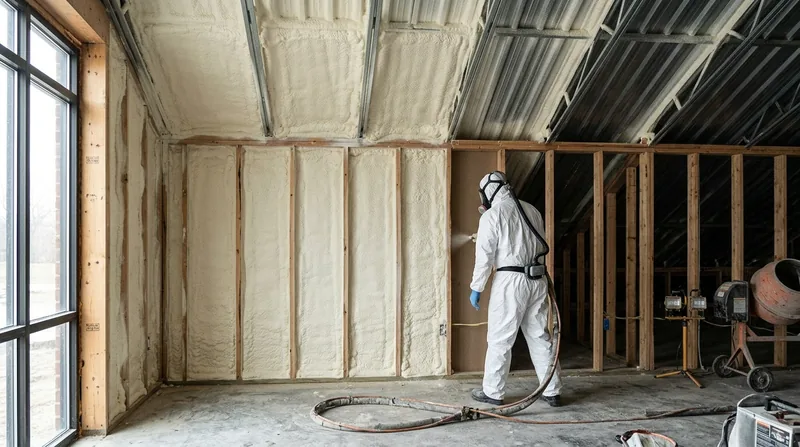




Commercial and new construction spray foam insulation in Iowa City and Johnson County starts at the framing stage, before drywall closes the walls and before roof decks are sealed. Eastern Iowa's climate, cold winters that push air out through every gap, hot humid summers that drive moisture inward, demands an air barrier installed right the first time. New builds in Coralville, North Liberty, and Tiffin that frame without foam end up with two-story homes over garages, vaulted ceilings, and rim joists that leak conditioned air all season. We spray building envelopes from the stud cavity out, so the thermal and air barrier is complete before the next trade arrives. That early decision saves money on HVAC sizing, eliminates cold spots above second-floor bedrooms, and keeps the building envelope tight through its first winter.
Why Commercial and New Construction Spray Foam Matters in Iowa City's Building Cycle
A new commercial shell or residential frame in Johnson County sits exposed for weeks or months. Standard fiberglass batts and blown-in cellulose leave thermal bridges at studs, gaps at top plates, and no control over air leakage once the envelope closes. Spray foam seals the stud cavity, the rim joist transition, and every mechanical penetration in one pass, so the building breathes only where you design it to. In Iowa City's climate zone 5A, that airtight envelope cuts winter heating load and summer cooling load equally. Builders and property managers across Coralville and North Liberty who spray foam at framing stage report easier HVAC commissioning, faster drywall crew work, and no callbacks for cold spots or moisture in the wall cavity.
- We spray closed cell or open cell foam directly onto the rim board and band joist before the basement rim is finished, stopping the number-one air leak in new basements across Johnson County.
- We foam interior walls before drywall goes up, sealing every stud cavity and mechanical chase in one application with no gaps or voids.
- We seal roof decks and rafter cavities before sheathing, so the thermal barrier is complete and no warm, moist air from the building interior can condense on the underside of the roof deck in winter.
- We work around HVAC, electrical, and plumbing rough-ins so trades do not have to cut and patch after we finish.
- We pull mechanical ventilation during cure and specify a re-entry window so the building stays on schedule and off-gassing does not delay drywall or other trades.
Spray foam at framing stage is the only insulation method that guarantees no air leakage, no settling, and no thermal bridges in the envelope.
Key info: A new two-story home in North Liberty with a vaulted great room and a garage below requires foam on the rim joist, the exterior walls, the band joist transition, and the roof deck above the garage. Closed cell foam at 1.5 to 2 inches on the roof deck stops condensation and ice damming in the Iowa winter, while open cell foam at 5 to 6 inches in the wall cavities delivers R-value and air sealing at a lower cost per board foot. The choice depends on the building's use, the HVAC plan, and the budget.
For permitting and code compliance in your specific city, always verify with your local building department. Contact us for a free commercial estimate, and we'll help you understand what applies at your address.
How We Spray Foam New Construction Envelopes in Iowa City: The Framing-Stage Approach
Our process starts with a site walk during framing, before the envelope closes. We identify all rim joists, band joists, mechanical penetrations, and roof deck areas. We schedule the spray between rough electrical and plumbing so we do not disturb their work, and we coordinate with the builder's timeline so drywall can go up the next day. We set up mechanical ventilation on site during cure, pull air continuously for the manufacturer's specified time, and provide a re-entry window so the building stays on schedule. Every foam application is measured and documented with R-value and thickness specs so the builder and the homeowner have proof of what was installed.
- We schedule the spray during the framing-to-drywall window, when the envelope is open and accessible from all sides.
- We apply closed cell foam at the rim joist and band joist transition to stop air leakage and condensation on the rim board in the first winter.
- We foam exterior walls cavity-by-cavity, working around studs, top plates, and any existing rough-ins so no cavity is missed.
- We seal roof decks and rafter cavities with closed cell foam to prevent ice damming and condensation on the underside of the deck in cold weather.
- We pull mechanical ventilation during cure, typically 24 to 48 hours depending on foam type and thickness, so the building is safe for re-entry and other trades.
- We document thickness and R-value on a site report so the builder has a record of what was installed and where.
This framing-stage approach means the air barrier is complete before any other trade cuts into the envelope.
Local example: A new commercial office building in Coralville with a metal stud frame and a standing-seam roof deck needs closed cell foam on the underside of the deck to control condensation in the Iowa summer humidity, plus spray foam in the rim joist and exterior walls to stop air leakage. We schedule the spray for the week after the roof is weathered in and before the interior walls are framed, so we have clear access to every stud cavity and the entire roof deck. The builder gets a complete thermal and air barrier in one trade cycle, no patching, no delays.
See how closed cell spray foam handles condensation control on metal buildings and sealed roof decks.
Spray Foam Methods for Commercial and New Construction Builds
| Approach | Description | Best for |
|---|---|---|
| Closed Cell Spray Foam on Rim and Roof Deck | Dense, rigid foam applied at 1.5 to 2 inches on rim boards and roof decks to stop air leakage and condensation. High R-value per inch, moisture barrier built in. | Basement rim joists, sealed roof decks, metal buildings, and any assembly exposed to humidity or temperature swing. |
| Closed Cell Spray Foam in Exterior Walls | Applied at 1.5 to 2 inches in stud cavities to provide air sealing and R-value while maintaining a vapor barrier in the wall assembly. | New construction exterior walls in zone 5A where condensation risk is high and air leakage must be zero. |
| Open Cell Spray Foam in Interior Walls and Cavities | Applied at 5 to 6 inches in stud cavities for air sealing and R-value. Lower cost per board foot, vapor permeable, sound dampening. | Interior walls, non-exterior cavities, and new builds where cost control is important and condensation risk is lower. |
| Spray Foam at Mechanical Penetrations | Low-pressure foam applied around HVAC ducts, electrical conduit, plumbing runs, and any hole through the envelope to seal air leakage at the source. | Every new build, applied after rough-ins are in place but before drywall closes the frame. |
Commercial and New Construction Spray Foam Cost in Iowa City: What to Expect
The cost of spray foam on a new commercial or residential build depends on the square footage of the envelope, the type of foam (closed cell or open cell), the thickness required by code and design, and the complexity of the framing. A new residential frame in Coralville with rim joists, exterior walls, and a sealed roof deck typically runs higher per board foot than an interior wall retrofit, because the scope is larger and the staging is tied to the builder's schedule. Closed cell foam costs more per board foot than open cell, but delivers higher R-value per inch and a built-in vapor barrier, so the total installed cost may be lower for a sealed roof deck or a humid rim joist. We provide a free commercial estimate that details the square footage, the foam type, the thickness in inches, and the total R-value so you see exactly what you are paying for and why.
Factors that move the cost up or down include the accessibility of the rim joist and roof deck (easy access from a basement or a low attic costs less than a high or narrow space), the number of mechanical penetrations (more holes to seal means more foam and more labor), and whether the building is occupied during the spray (occupied buildings require extended ventilation and re-entry protocols). A new build with a straightforward rectangular footprint and clear access costs less per board foot than a complex shape with many corners and mechanical chases. The best way to understand your actual cost is to request a free estimate. Call us at (319) 600-6306 or fill out the contact form and we'll schedule a site visit within 24 hours.
What to Look for When Hiring a Spray Foam Contractor Near Iowa City
Spray foam is a high-performance product, but only if it is installed correctly. An estimate that lists a price with no R-value, no thickness, and no mention of mechanical ventilation during cure is a red flag. A contractor who promises immediate re-entry or same-day occupancy is cutting corners on ventilation and violating the manufacturer's protocol. Always verify that your contractor is fully insured, ask for a certificate of insurance, and confirm that their coverage includes the specific work you are asking them to do. Get 2 to 3 estimates so you can compare scope, materials, and price. Ask each contractor how they handle mechanical ventilation during cure, what re-entry window they specify, and whether they provide a written report with R-value and thickness documented.
- Confirm that the contractor is fully insured and ask for a certificate of insurance that names your project or your address.
- Request a written estimate that lists the square footage, the foam type (closed cell or open cell), the thickness in inches, and the total R-value so you can compare apples to apples across contractors.
- Ask how the contractor handles mechanical ventilation during cure and what re-entry window they specify before drywall or other trades can proceed.
- Check references from recent commercial or new construction projects in Iowa City or nearby, and ask about the timeline, the quality of the installation, and any issues after the foam cured.
- Verify that the contractor understands your local building code and permitting requirements, and confirm who is responsible for pulling permits if your project requires them.
- If your building is part of a commercial development or HOA, confirm that the spray foam work meets any architectural or structural requirements and does not void any existing warranties on the building envelope.
The local contractor with a local address and local plates is your best resource for navigating Iowa City's permitting and climate-specific needs. Contact us today for a free commercial estimate and a conversation about your project.
Commercial & New Construction Spray Foam in Iowa City: Pricing Guide
| Service | Price | Details |
|---|---|---|
| Free Commercial Estimate | Free | Site visit, measurement, and written scope with R-value and thickness specifications, no obligation to book |
| Rim Joist and Band Joist Foam | Starting at $1,200 | Closed cell foam on basement rim and band joist, typical for new residential builds in Iowa City and surrounding areas |
| Exterior Wall Cavities and Sealed Roof Decks | On estimate | Cost depends on building footprint, wall cavity depth, roof deck area, and foam type selected for your envelope |
| Commercial or Complex Envelope | On estimate | Metal buildings, barndominiums, and multi-zone envelopes require site measurement and detailed scope before pricing |
| Travel and Scheduling | Included | No separate mileage or call-out fee within Iowa City and Johnson County service area |
Indicative pricing, the exact cost depends on square footage, finish, and site access. Free personalized estimate within 24h at (319) 600-6306.


