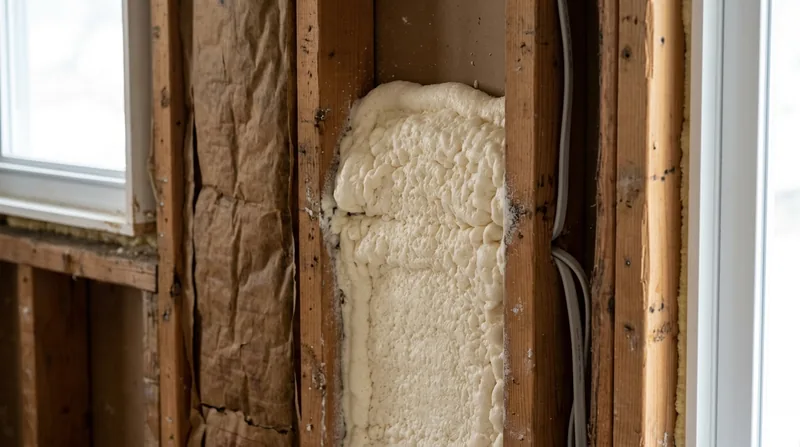




Open cell spray foam insulation in Iowa City fills the stud bays of older Northside and Longfellow homes where balloon-frame walls leak air, seals vaulted ceilings in newer Coralville and North Liberty subdivisions without adding weight, and solves the sound-dampening challenge in student rentals near campus that turn over every August. Iowa City's climate, IECC zone 5A with cold, windy winters and hot, humid summers, drives conditioned air out through top plates and penetrations in winter, then pulls moisture inward through leaky walls and roof decks in summer. Open cell foam expands to fill gaps inside cavities, stops that seasonal air reversal, and costs less than closed cell because it carries a lower R-value per inch and is lighter. If your attic is already insulated but still cold above the bedroom, or if your vaulted ceiling in a newer home needs air sealing without bulk, open cell is the answer. We help Iowa City homeowners understand whether open cell, closed cell, or blown-in fiberglass is the right choice for their specific house and climate zone, and we build the scope to fit the budget.
Why Open Cell Spray Foam Matters in Iowa City's Older and Newer Homes
Northside homes built before 1950 often have balloon-framed walls where fiberglass batts settled decades ago, leaving cold spots and drafts that no amount of weatherstripping fixes. Newer two-story homes in Coralville, North Liberty, and Tiffin bring vaulted ceilings and rooms over garages where traditional batts bridge the rafter cavity unevenly, creating thermal bridges and condensation risk on cold mornings. Open cell foam expands to fill those cavities completely, seals gaps that fiberglass leaves open, and reduces air infiltration without the weight penalty of closed cell. In Iowa City's cold winters, that air sealing translates directly to fewer drafts and more even room temperatures. Open cell also absorbs sound, which matters in student rentals and homes near campus where noise travels through walls.
- We fill balloon-frame stud cavities in pre-1950 homes to stop cold spots and drafts that settled fiberglass cannot reach.
- We seal vaulted ceilings in newer subdivisions without the bulk or weight of closed cell foam.
- We air-seal around electrical outlets, top plates, and rim joists during the spray to stop seasonal air reversal.
- We deliver sound dampening in interior walls, which student rental properties and multi-unit homes depend on.
- We inspect existing insulation first and recommend open cell only when it is the right answer for the job.
Getting the right foam type for the right space is what separates a durable retrofit from a repair that fails in five years.
Local example: A Longfellow Avenue home with balloon-frame walls and settled batts in the stud cavities gets open cell foam injected from the attic without tearing drywall. The foam expands to fill the cavity completely, stops the draft at the top plate, and keeps the bedroom above the living room 6 to 8 degrees warmer in January. Cost is lower than closed cell because open cell carries an R-value of 3.5 to 3.7 per inch, versus 6.5 to 7.0 for closed cell, and the homeowner's winter heating bill drops measurably.
For more detail on how spray foam air sealing works across your whole home, see our air sealing service page.
How We Install Open Cell Spray Foam in Iowa City Homes
Open cell spray foam installation starts with a site inspection to measure the cavity depth, check for moisture, existing insulation, and penetrations, then calculate the board feet needed. We remove old fiberglass or settled batts if the cavity is contaminated or the existing insulation is blocking access; vermiculite is never disturbed until it has been tested for asbestos. We set up mechanical ventilation during the spray to manage VOC release, spray the foam in controlled passes to hit the specified thickness, and keep the home sealed for 24 to 48 hours while it cures. Thickness and density are recorded on the invoice so you have proof of what was installed. After cure, we air-seal around electrical boxes, rim joists, and band joists to complete the air barrier.
- We inspect the cavity, measure existing insulation, and identify any moisture or contamination before we spray.
- We remove old fiberglass or insulation that blocks access or sits on a wet substrate, or we walk away if moisture cannot be dried first.
- We set up mechanical ventilation during application to control VOC and odor during the cure window.
- We spray in controlled passes, holding the specified thickness and density per the manufacturer specification.
- We document the R-value and thickness on the invoice so you have a written record for insurance and resale.
- We air-seal penetrations and rim joists to complete the thermal envelope and stop seasonal air leakage.
Controlled installation is the difference between a foam that lasts 20 years and one that fails or smells in five.
Example in Coralville: A newer two-story home with a vaulted ceiling over the master bedroom has open cell foam sprayed into the rafter cavity from the attic side. The foam fills the 5.5-inch cavity to R-18, stops thermal bridging through the rafters, and seals the air gap where the drywall meets the top plate. No interior demolition, no weight added to the roof structure, and the room stays consistent with the rest of the home in winter and summer.
To understand how this work fits with attic spray foam insulation and full-attic sealing, see our attic service page.
Open Cell Installation Methods and Best Applications
| Method | Description | Best For |
|---|---|---|
| Cavity fill (open cell) | Foam sprayed into wall cavities, rafter bays, or joist spaces from attic or interior access, expanding to fill the cavity completely. | Older balloon-frame walls, vaulted ceilings, rim and band joists, attic knee walls in newer homes. |
| Injection foam (open cell) | Holes drilled in drywall or exterior sheathing, foam injected into sealed cavities, holes patched after cure. | Pre-1980 homes with closed stud bays, retrofit without interior demolition, sound dampening in rental properties. |
| Attic top-up (open cell) | Open cell foam sprayed over existing blown-in fiberglass to add R-value and seal air leakage paths at penetrations and rim joists. | Attics with settled or thin original insulation, where adding closed cell weight is not an option. |
| Basement rim and band joist (open cell) | Foam sprayed on the interior rim joist band, sealing the rim from the basement side to stop cold air and moisture infiltration. | Iowa City basements where the rim joist sits above grade and is the primary air leak and condensation point in winter. |
Open Cell Spray Foam Insulation Cost in Iowa City: What to Expect
Open cell spray foam in Iowa City starts at approximately $0.55 per board foot for standard cavity fill in attics and walls, with most residential jobs ranging from $0.55 to $0.75 per board foot depending on access, cavity depth, and the amount of old insulation removal required. A typical attic top-up in a Coralville or North Liberty home runs 200 to 400 board feet and costs $110 to $300 before any removal work. Injection foam into closed walls costs more per board foot because of the drilling, patching, and slower application, but avoids interior demolition. Rim joist sealing in a full basement runs 50 to 100 board feet and is often the entry-point job for homeowners who want to test the process at lower cost.
The factors that move your cost up or down are cavity depth (deeper cavities need more material), existing insulation removal (old fiberglass or mineral wool adds labor), access difficulty (attics with low headroom or tight rafter bays slow the spray), and moisture remediation if the substrate is damp. Getting two or three written estimates with R-value and thickness specifications is the only way to compare fairly. We provide pricing guidance on our full pricing page, and every estimate includes the board-foot calculation, the R-value per inch, the total thickness, and the re-entry window so you know exactly what you are paying for.
If your attic is already insulated with fiberglass and you just need to add R-value over the top, blown-in cellulose or fiberglass is sometimes cheaper and is the right answer. We will tell you that if it applies to your home.
Open Cell Spray Foam Insulation Near Me: What Iowa City Homeowners Should Know When Hiring
When you call a spray foam contractor in Iowa City, ask for a written estimate that includes the R-value per inch, the total thickness in inches, and the board-foot total. Ask whether they pull permits if your city requires them (Iowa City, Coralville, and North Liberty have different rules, so defer to the local building department). Verify that the contractor is fully insured and ask for a copy of the insurance certificate. Check references from at least two completed jobs in Johnson County, and ask those homeowners whether the smell during cure was managed, whether the re-entry window was respected, and whether the invoice matched the estimate. If a contractor promises immediate re-entry, guarantees energy savings in dollars, or quotes a price far below the market range, that is a red flag.
- Request a written estimate that specifies R-value per inch, total thickness, and board-foot quantity so you can compare fairly across contractors.
- Confirm that the contractor is fully insured and ask for proof of insurance coverage before work begins.
- Ask about permitting: Iowa City, Coralville, and North Liberty have different requirements, and the contractor should help you navigate what applies at your address.
- Call two or three references from recent jobs in the area and ask about odor management, the re-entry window, and whether the invoice matched the estimate.
- Avoid any contractor who promises immediate re-entry or quotes a price far below the market without an on-site inspection.
The right contractor will answer your questions directly, show up on time, and explain why open cell is or is not the right choice for your specific home. Contact us for a free estimate with no obligation to book.
Open Cell Spray Foam Insulation in Iowa City: Pricing Guide
| Service | Price | Details |
|---|---|---|
| Open cell cavity fill (attic or walls) | Starting at $0.55/board ft | Standard application in accessible cavities, includes mechanical ventilation during cure and documentation of thickness and R-value |
| Injection foam into closed walls | Starting at $0.70/board ft | Drilling, foam injection, and patch repair included; higher cost per board foot due to slower application and finishing work |
| Attic top-up over existing insulation | Starting at $0.60/board ft | Open cell sprayed over settled fiberglass to add R-value and seal air leaks; cost varies with existing insulation depth and removal needs |
| Rim and band joist sealing | Starting at $0.55/board ft | Basement rim joists sealed from interior side; typical job is 50 to 100 board feet, entry-point price for homeowners testing the process |
| Insulation removal and disposal | On estimate | Old fiberglass, mineral wool, or contaminated insulation removed and disposed of before new foam is installed; labor depends on volume and condition |
| Free written estimate | No cost, no obligation | Response within 24 hours at (319) 600-6306; includes board-foot calculation, R-value, thickness, and re-entry window |
Indicative pricing, the exact cost depends on square footage, finish, and site access. Free personalized estimate within 24h at (319) 600-6306.


