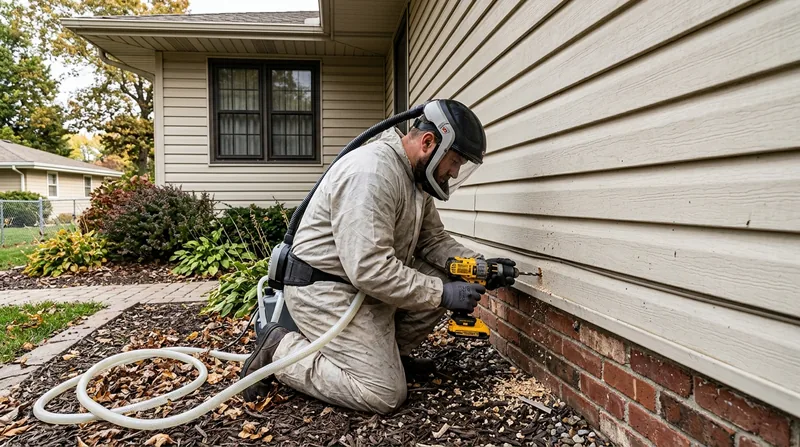




Wall & Injection Foam Insulation in Iowa City addresses a specific problem in Johnson County's older housing stock: uninsulated or poorly insulated wall cavities in homes built before modern building codes. The Northside and Longfellow neighborhoods, with their early-1900s balloon-frame construction and mid-century ranches across Iowa City and Coralville, often have hollow stud bays that settled fiberglass batts no longer fill. Injection foam fills those cavities from the inside without tearing out plaster, drywall, or brick. In Iowa's climate zone 5A, where cold winters drive conditioned air out through leaky walls and hot, humid summers push moisture inward, sealing those cavities stops both the draft and the seasonal moisture reversal that ages plaster and rots rim joists. We drill small access holes, inject closed-cell or open-cell foam into existing wall cavities, and seal the holes. The result is a warmer, drier wall assembly that holds its R-value for decades. This page walks you through the method, the cost, and how to hire the right contractor near you.
Why Wall & Injection Foam Insulation Matters in Iowa City's Older Homes
Iowa City's housing stock splits into two insulation problems. The Northside and Longfellow rentals and owner-occupied homes, built in the 1910s through 1940s, have balloon-framed walls with no fire stops between floors and cavities that were never insulated at all or were filled with sawdust and newspaper that settled decades ago. Mid-century ranches built in the 1950s and 1960s have stud bays with thin fiberglass that compressed or was never fully installed. Neither type can be re-insulated from inside without demolition. Injection foam solves that: we access the cavity from outside or inside, drill a small hole every 16 inches, and inject foam that expands to fill the space, sealing air leaks and adding R-value without disturbing the interior finish.
- Older homes in Iowa City lose heated air through hollow or partially filled walls, especially at rim joists where walls meet basements.
- Injection foam fills cavities from inside the wall without requiring plaster removal, drywall demolition, or exterior siding tear-out.
- The foam cures to a rigid structure that resists settling, moisture, and air movement for the life of the home.
- Iowa's seasonal moisture reversal (cold dry winters, hot humid summers) makes a sealed wall cavity critical to prevent condensation and mold on the rim joist.
Sealing wall cavities is often the most cost-effective retrofit for Johnson County homes because it requires no structural change and no interior disruption.
Key info: A 1950s ranch in Iowa City with original fiberglass in the walls loses roughly 15 to 25 percent of its heating energy through air leaks in the wall cavities, especially where the walls meet the basement rim joist. Injection foam seals those leaks and adds R-value in a single pass.
For more detail on the broader insulation strategy for your home, see our guide to Attic Spray Foam Insulation in Iowa City, which often pairs with wall injection to maximize energy performance. You can also review Iowa City's Planning and Zoning Department for any questions about permits or historic preservation requirements in the Northside district.
How We Inject Foam Into Walls: The Process in Iowa City
Injection foam work is a precise, methodical process that requires access to the wall cavity, careful hole placement, and controlled foam application. We begin with a site visit to assess the wall type, cavity depth, and any obstacles like electrical wiring or plumbing. For a typical Northside home with 2x4 stud bays, we drill 1-inch access holes on 16-inch centers, either from the exterior (if siding is removable) or the interior (if we can access the wall behind furniture or trim). We inject closed-cell or open-cell foam, depending on the wall's exposure and your moisture profile. The foam expands slightly to fill the cavity and cures to a solid structure. We seal the access holes with plugs or caulk, matching the existing finish. The entire job takes one to three days depending on wall length and cavity accessibility.
- We drill small access holes (typically 1 inch) spaced 16 inches apart along the wall cavity.
- We inject foam at controlled pressure and temperature to fill the cavity without over-pressurizing the wall structure.
- The foam expands slightly and cures to a rigid, moisture-resistant solid within 24 to 48 hours.
- We seal all access holes with foam plugs or caulk and touch up the finish to match the wall.
- We provide a written estimate with R-value and cavity thickness so you know exactly what you are getting.
The key difference between injection foam and blown-in fiberglass is permanence: injection foam does not settle, compress, or shift with seasonal temperature changes.
Example: A split-level rental on the Northside in Iowa City with 1920s balloon-frame walls and settled fiberglass had cold spots above the bedrooms and high heating bills. We injected closed-cell foam into the exterior walls on the north and west sides, drilling from the interior to avoid disturbing the original brick. The cavity was filled to R-13 in a 2x4 frame. The homeowner reported a 10-degree drop in peak heating demand and no cold spots the following winter.
For a complementary approach to rim joist and band joist sealing, see our Rim Joist & Band Joist Spray Foam service, which often pairs with wall injection on basement-level walls.
Wall Injection Methods: Closed-Cell vs. Open-Cell Foam
| Foam Type | Description | Best for |
|---|---|---|
| Closed-Cell Injection Foam | High-density foam with a closed-cell structure that resists moisture and air movement. Typical R-value 6 to 7 per inch. Cures rigid and hard. | Exterior walls in Iowa City subject to wind-driven rain and seasonal moisture reversal, especially rim joists and basement-level walls where humidity is high. |
| Open-Cell Injection Foam | Lower-density foam with open cells that allow some moisture vapor to pass. Typical R-value 3.5 to 4 per inch. Cures soft and flexible. | Interior walls in Iowa City where moisture control is less critical and cost is a priority. Not recommended for exterior walls or below-grade cavities. |
| Partial-Fill Injection | Injecting foam to a partial depth (e.g., 2 to 3 inches in a 3.5-inch cavity) to reduce cost while still sealing air leaks and adding measurable R-value. | Mid-century ranches in Iowa City where budget is tight and the wall is already partially insulated with fiberglass batts. |
| Full-Cavity Injection | Filling the entire stud bay depth (typically 3.5 inches for 2x4 walls) with foam to maximize R-value and air sealing. | Northside and Longfellow homes in Iowa City where the cavity is hollow or has only settled insulation, and energy performance is the priority. |
Wall & Injection Foam Insulation Cost in Iowa City: What to Expect
Wall injection foam pricing starts at approximately $2 per square foot of wall cavity filled, but the actual cost depends on several concrete factors specific to your home and location in Johnson County. A typical 1,000-square-foot exterior wall on a mid-century ranch in Iowa City or Coralville runs between $2,000 and $3,500 for a full-cavity closed-cell fill. Partial fills cost less, and interior walls (which are less critical for moisture control) can be done with open-cell foam at a lower rate. The factors that move the price are wall cavity depth (2x4 vs. 2x6), the type of foam (closed-cell or open-cell), whether the wall is accessible from inside or outside, the presence of obstacles like electrical wiring or plumbing, and the linear footage of wall to be treated.
Access is the biggest variable. A wall that can be accessed from the interior (behind removable trim or in a basement) costs less than one requiring exterior siding removal or scaffolding. A Northside home with brick veneer and an inaccessible cavity will cost more than a ranch with removable vinyl siding. The cavity condition also matters: a wall with settled fiberglass requires less foam to reach target R-value than a completely hollow wall.
We always provide a written estimate that specifies the R-value you will receive, the cavity thickness, the foam type, and the total square footage. This prevents surprises and lets you compare our estimate with others. Most jobs in Iowa City take one to three days, so labor costs are predictable. We recommend getting 2 to 3 estimates before deciding, because access difficulty and cavity condition can vary significantly from one home to the next.
For a detailed breakdown of pricing across all our services, visit our full pricing page. To get a free estimate for your specific wall, contact us at (319) 600-6306. We respond within 24 hours and can often schedule a site visit within a few days.
What to Look for When Hiring a Wall & Injection Foam Contractor Near Iowa City
Choosing the right spray foam contractor is as important as choosing the right method. Iowa City and Johnson County have no specific spray foam licensing regime that we have verified, so the burden falls on you to check credentials and understand what you are paying for. A reputable local contractor will provide a written estimate with R-value and thickness specs, carry full insurance with a certificate available on request, and be reachable after the job is complete. Avoid contractors who quote a price per board foot without a site visit, promise immediate re-entry into the home, or offer estimates with no detail on R-value or cavity fill. Those are the markers of a rig-and-run operation that will leave you with incomplete insulation, odor problems, or no recourse if something goes wrong.
- Request a written estimate that specifies R-value, cavity thickness, foam type, and total square footage.
- Verify that the contractor is fully insured and ask for a certificate of insurance naming your address as the job location.
- Ask about the cure time and re-entry window: honest contractors state 24 to 48 hours and require mechanical ventilation during cure.
- Check references from recent jobs in Iowa City, Coralville, or North Liberty, and ask whether the homeowner had any odor or follow-up issues.
- Confirm that the contractor understands local permitting: some cities in Johnson County require notification before insulation work, and the building official has the final say on ignition barriers and thermal barriers.
- Ask whether the contractor will inspect the cavity before quoting to ensure there is no moisture, mold, or active leaks that need remediation first.
A local contractor with a local address, local plates, and a reputation in Iowa City is your best safeguard. We have been in business since 2014 and have completed hundreds of wall injection jobs across Johnson County. Call us at (319) 600-6306 for a free, no-obligation estimate and to ask any questions about method, cost, or our insurance and references.
Wall & Injection Foam Insulation in Iowa City: Pricing Guide
| Service | Price | Details |
|---|---|---|
| Wall Injection Foam (Closed-Cell, Full Cavity) | Starting at $2/sq ft | Full-cavity fill in 2x4 stud bays with closed-cell foam, R-value 6 to 7 per inch, sealed holes, includes access holes and caulk |
| Wall Injection Foam (Partial Fill or Open-Cell) | Starting at $1.50/sq ft | Partial-depth fill or open-cell foam in accessible interior walls, lower cost option when budget is tight and moisture is not critical |
| Complex Access (Exterior Siding Removal, Scaffolding) | On estimate | Walls requiring temporary siding removal, scaffolding, or professional access equipment cost more due to setup and restoration labor |
| Travel and Site Visit | Included | No charge for site visits within Iowa City, Coralville, North Liberty, and surrounding Johnson County service areas |
| Free Estimate with R-Value and Thickness Specs | Free | Written estimate provided within 24 hours, specifying R-value, cavity thickness, foam type, and total square footage, no obligation to book |
Indicative pricing, the exact cost depends on square footage, finish, and site access. Free personalized estimate within 24h at (319) 600-6306.


