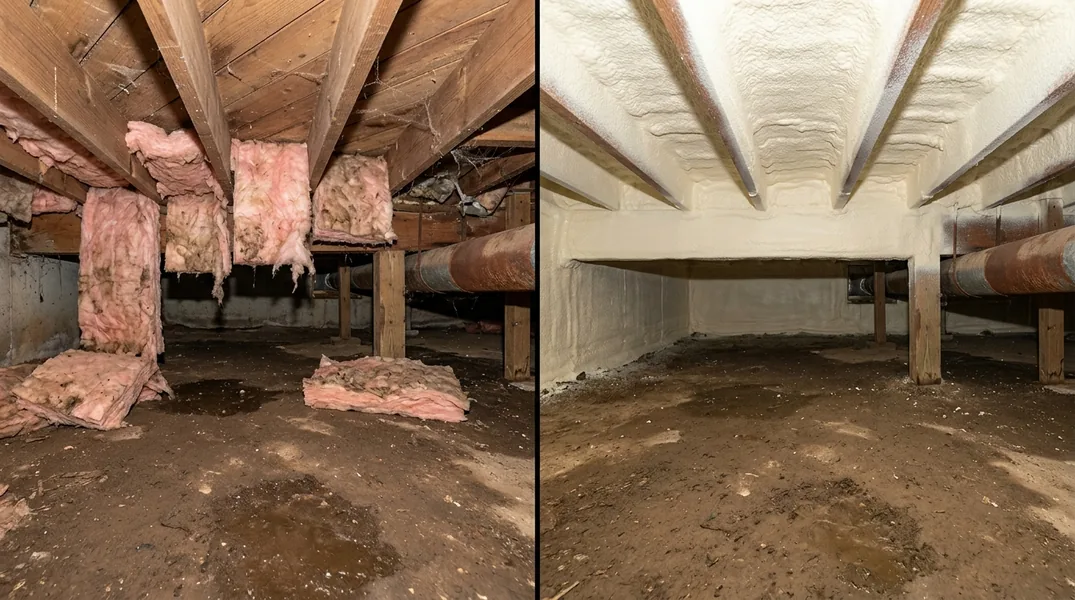
Why Iowa City Homes Struggle with Summer Moisture
The Midwest summer climate presents a unique challenge for homeowners. When warm, humid air collides with cool interior surfaces, condensation forms, creating the perfect environment for mold, mildew, and wood rot. Iowa City experiences average summer humidity levels that can exceed 70 percent, and that moisture doesn't just disappear when temperatures drop in the evening.
Traditional fiberglass and cellulose insulation materials absorb moisture like a sponge. Once saturated, they lose their insulating effectiveness and become breeding grounds for mold colonies. Homeowners in the area often notice musty odors in their attics by mid-summer, peeling paint in basements, and that telltale dampness that makes rooms feel uncomfortable even with air conditioning running. The problem compounds over time, leading to structural damage that becomes expensive to repair.
This is where modern spray foam insulation offers a game-changing solution. Unlike traditional materials, spray foam creates an air-tight seal that prevents moisture infiltration while actively resisting water absorption. For homes in Iowa City, this means real relief from persistent humidity problems and the damage that follows.
Attic Spray Foam Insulation Near Me: Why Your Attic Is Ground Zero
Your attic is often the first place moisture problems develop. Hot summer air rises, and when it meets the cooler roof deck, condensation happens almost instantly. Attic Spray Foam Insulation addresses this problem at its source by sealing every gap, crack, and penetration where humid air can enter. The foam expands to fill irregular spaces that traditional batt insulation simply cannot reach, creating a complete thermal and moisture barrier.
Many homeowners don't realize that their attic ventilation strategy, while important, isn't always enough to manage the moisture load during humid Iowa summers. Attic Spray Foam Insulation works in concert with proper ventilation to keep moisture levels in check. The air-tight seal prevents warm, humid interior air from rising into the attic space in the first place, while the foam's inherent resistance to water absorption means that any moisture that does accumulate won't degrade the insulation's performance.
When you invest in professional Attic Spray Foam Insulation, you're also gaining better temperature control year-round, which reduces the strain on your HVAC system and lowers energy bills. For homeowners in Iowa City dealing with damp attics, this is often the turning point in their home comfort story.
Closed Cell vs. Open Cell: Choosing the Right Foam for Moisture Control
Closed Cell Spray Foam Insulation is the superior choice for moisture-prone environments. This dense foam type has a cellular structure where each cell is completely sealed, preventing water from penetrating the material. It offers an R-value around 6 to 7 per inch, making it incredibly efficient in tight spaces. For basements, crawl spaces, and attics where humidity is a real concern, closed cell foam is the industry standard.
Open Cell Spray Foam Insulation, by contrast, has a more permeable structure and an R-value closer to 3.5 per inch. While it's more affordable and works well in some applications, it's not ideal for areas exposed to high moisture levels. Open cell foam can absorb water, which means it's better suited to interior walls in dry environments rather than basements or attics in humid climates.
For homes in Iowa City facing persistent dampness, Closed Cell Spray Foam Insulation is the smarter investment. It provides superior moisture resistance, higher R-value efficiency, and longer-term protection against the humid summers and damp basements that plague the region. The slightly higher upfront cost is quickly offset by energy savings and the prevention of costly moisture-related damage.
Metal Building and Barndominium Insulation: Moisture Solutions for Non-Traditional Homes
Homeowners with metal buildings, barndominiums, or pole barns face a unique moisture challenge. Metal conducts temperature extremely efficiently, which means condensation forms readily on interior metal surfaces when humid air meets the cool metal shell. This creates what builders call the sweating metal problem, where water literally drips from walls and ceilings during temperature swings. Traditional insulation methods struggle to address this because they don't seal the thermal bridge created by the metal structure itself.
The best insulation for metal building applications is spray foam. Closed Cell Spray Foam Insulation adheres directly to the metal surface, creating a continuous thermal barrier that eliminates the temperature differential where condensation forms. For barndominium insulation and pole barn insulation, this approach is transformative. The foam fills every irregular space where the metal framework meets walls and ceiling, preventing air infiltration and moisture migration.
Steel building insulation and metal building insulation both benefit tremendously from spray foam's unique properties. Unlike batts or blankets that leave gaps around structural members, spray foam creates a monolithic barrier. This means your metal building stays dry, your indoor air quality improves, and your energy costs drop significantly. If you're converting a metal structure into living space or upgrading an existing agricultural building, spray foam is the proven solution for eliminating moisture problems that plague these structures in humid climates.
Basement and Crawl Space Protection from Iowa's Humid Climate
Basements and crawl spaces are naturally vulnerable to moisture intrusion, and Iowa's climate amplifies the problem. Groundwater, surface water, and soil moisture all find their way into below-grade spaces, especially during spring thaw and summer rain events. The humidity that results creates an environment where mold thrives and structural materials deteriorate. Many homeowners don't realize that their basement moisture problem is connected to their attic problem, both driven by the same underlying issue: inadequate moisture control in the building envelope.
Wall & Injection Foam Insulation can be applied to basement walls and rim joists to create a moisture-resistant thermal barrier. When combined with proper drainage and dehumidification, spray foam transforms a damp basement into a dry, usable space. The foam's impermeability means that moisture vapor from the soil side cannot pass through the insulation, while the air-tight seal prevents humid interior air from condensing on cold surfaces.
For crawl spaces, the approach is similar but even more critical. These confined spaces are often the source of moisture problems that affect the entire home. Spray foam applied to crawl space walls and band joists creates a complete encapsulation that isolates the space from ground moisture. This single improvement often eliminates musty odors throughout the home and prevents the mold growth that can compromise air quality and health. If you're dealing with a damp basement or crawl space in Iowa City, professional spray foam insulation is one of the most effective solutions available.
Spray Foam Insulation Cost in Iowa City: What to Budget
The pricing for spray foam insulation varies based on several factors, including the type of foam (closed cell versus open cell), the area to be insulated, accessibility, and existing conditions. Closed cell foam typically costs more per square foot than open cell, but for moisture-prone applications like attics and basements, it's the better value because it performs better and lasts longer. Most homeowners spend between 1,500 and 5,000 dollars for a complete attic insulation project, depending on attic size and the R-value target.
When evaluating pricing, it's important to consider the long-term return on investment. Spray foam typically saves 15 to 30 percent on heating and cooling costs, pays for itself within five to ten years, and prevents expensive moisture damage that would otherwise require structural repairs. A damp basement remediation using spray foam might cost 2,000 to 4,000 dollars upfront, but it prevents tens of thousands in potential mold remediation, wood replacement, and foundation repair down the road.
The best way to understand your specific costs is to request a free estimate from Iowa City Spray Foam Insulation. Our team will assess your home's unique moisture challenges, recommend the right foam type and application method, and provide transparent pricing with no hidden fees. Call us at (319) 600-6306 to schedule your consultation today.
Taking Action: Protect Your Iowa City Home from Moisture
Humid summers and damp basements don't have to be a permanent part of life in Iowa City. Modern spray foam insulation offers a proven, science-backed solution that addresses moisture at its source while improving energy efficiency and indoor air quality. Whether you're dealing with a musty attic, a sweating metal building, or a perpetually damp basement, spray foam insulation is the upgrade that delivers real, measurable results.
Iowa City Spray Foam Insulation has the expertise to diagnose your home's moisture problems and recommend the right solution. We work with homeowners throughout the area, including Coralville, North Liberty, and Tiffin, to transform uncomfortable, inefficient homes into comfortable, healthy spaces. Don't wait for next summer's humidity to remind you of the problem. Contact us today at (319) 600-6306 or request a free estimate to learn how spray foam insulation can protect your home and your family.
Looking for a professional spray foam insulation contractor in Iowa City? Iowa City Spray Foam Insulation responds fast for all your spray foam insulation needs.
Get a Free Quote